


Issues
Fiscal Responsibility
In 2024, a pattern of historic financial mismanagement was discovered by the Town’s new Comptroller, prompting the Town Board to commission a forensic review of Greenburgh’s 2020–23 finances. The resulting January 2026 EFPR report identified serious lapses in financial management and oversight, including uncollected revenue, unreconciled accounts, and the use of “plug” entries to balance accounts without real funds.
Most significantly, the report highlighted $29.4 million in uncollected property taxes and the improper handling of $32 million that had been earmarked for the courthouse-police complex capital fund. All told, a deficit of about $100 million was identified, much of which the Town may not be able to recoup. Over Supervisor Feiner’s objection, in March 2026 the Town Board issued a formal request for an investigation by the NY State Comptroller’s Office.
Incumbent Supervisor Paul Feiner has attempted to pass blame on others, however the fact is that oversight of Town finances is a Supervisor’s core duty. After serving as chief fiscal officer for more than 34 years, the ultimate responsibility for Greenburgh’s financial issues lies with him.
Barry McGoey will be ready on day one to set Greenburgh on a new course. Informed by his background in internal auditing, accounting, and the law, Barry will work with the Town staff and Board to complete a thorough reckoning of the Town’s finances—and to ensure that mismanagement of this magnitude never happens again.
Term Limits
If elected, Barry would seek to implement and abide by a 12-year cap on consecutive terms for Greenburgh Town Supervisor and Town Council members. Term limits reduce the risk of power entrenchment and prioritize institutional strength over individual office holders. By creating room for new people and diverse perspectives, term limits promote greater oversight, innovation, and responsiveness to constituents.
Affordable Housing
Clear, data-driven insight into housing supply, cost burdens, demographic trends, and gaps in available units, among other factors, is essential to crafting effective policy for affordable housing. A comprehensive housing needs assessment provides a detailed picture of who is being priced out, what types of housing are needed, and where strategic investments or zoning changes may be warranted.
This is not a new or untested approach. Westchester County successfully utilized a housing needs assessments at the county level to better plan for growth and affordability, demonstrating how valuable this tool can be. With that as a model, Greenburgh can move beyond guesswork and take targeted, responsible action to make the town more affordable and accessible for current and future residents.
Flood Mitigation
Water does not recognize municipal boundaries or property lines. It is imperative that Greenburgh work in a coordinated fashion among town departments and with its municipal and nonprofit partners so that it can invest efficiently and effectively for the future. We need a strategic town-wide approach to remediating vulnerable areas, prioritizing infrastructure investments, and protecting residents and businesses from increasingly frequent and severe weather events.
Notably, Greenburgh's flooding plan has not had a major overhaul in over a decade. It should be maintained as a living document, one that is regularly updated to reflect new data, emerging risks, and evolving best practices so that Greenburgh can remain proactive rather than reactive.
THE TOWN OF GREENBURGH
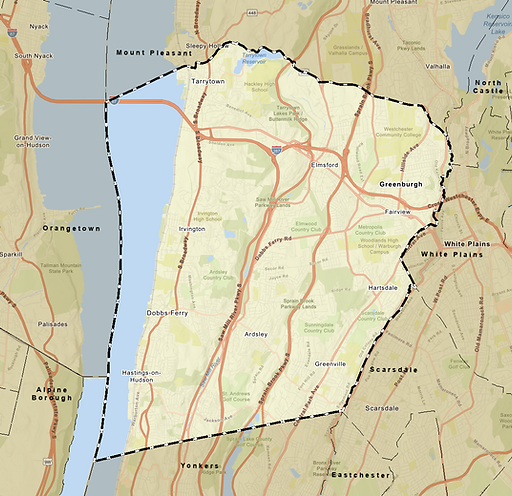
The Town of Greenburgh encompasses 36.1 square miles and a population of more than 95,000. About half of the Town’s residents live in the unincorporated area, which includes the communities of East Irvington, Edgemont, Fairview, Hartsdale, North Elmsford, and South Ardsley. About half of the Town’s residents live in the six villages of Ardsley, Dobbs Ferry, Elmsford, Hastings-on-Hudson, Irvington, and Tarrytown.
The Town’s adopted budget for fiscal year 2026 totaled $134.7 million—with $25.6 million in the town-wide “A” budget, and $109.1 million in the “B” budget for the unincorporated area. In addition to its own levies, the Town serves as tax collector for Westchester County, ten local school districts, fire protection, and multiple special districts.
Central Park Avenue Revitalization
Central Park Avenue is one of our most important commercial corridors. Unfortunately, years of inconsistent planning and maintenance, and a lack of long-term vision have left portions underperforming and unattractive. As Supervisor, Barry would make revitalizing Central Park Avenue an economic development priority by establishing a Central Park Avenue Revitalization Task Force comprised of Town officials, planning professionals, residents, business owners, and property owners to develop a comprehensive improvement plan with measurable goals and timelines. Strengthening code enforcement will ensure that existing standards are being applied consistently and fairly, and would help the Building Department identify potential code changes to address issues not covered by current regulations.
At the same time, Barry would pursue a comprehensive strategy for improving the corridor’s appearance, safety, and economic vitality with streetscape and pedestrian enhancements, including landscaping, tree planting, sidewalks, lighting, crosswalks, traffic-calming measures, and gateway features. Economic development should be driven by community needs, and Barry would work to attract and retain businesses that residents want while ensuring future development remains consistent with the character of surrounding neighborhoods.
Edgemont Incorporation
Barry is opposed to Edgemont incorporation. As highlighted in the 2024 CGR report, the best-case scenario for both the residents of Edgemont and the rest of the Town is that, after a potentially long and expensive negotiation process, a new Village of Edgemont purchases from the Town the very same services they currently receive from the Town. The worst-case scenario is that a new Village of Edgemont obtains its services elsewhere, dealing a devastating financial blow to the rest of the Town, while Edgemont taxpayers assume the costs and significant financial and operational risks of establishing a new layer of government. Because of these possible outcomes, and the potential for other unintended consequences, Barry opposes Edgemont incorporation and would work to resolve the root causes behind the push for Edgemont incorporation.
The incorporation campaign reflects years of frustration with a general lack of leadership and reckless decisions under Supervisor Feiner, particularly on land use and municipal services. Over the past nine years, pro-incorporation advocates have filed, and Supervisor Feiner has rejected, three petitions to hold a vote. The first two petitions for a vote on incorporation were upheld in State Supreme Court, before being overturned on appeal; the third was upheld in March 2026, and Supervisor Feiner is now appealing. This has driven taxpayer-funded legal costs to roughly $400,000. Much of this could have been avoided through stronger leadership and open dialogue. As Supervisor, Barry would pursue a negotiated resolution that protects taxpayers and minimizes financial harm to Greenburgh residents, while doing everything he can to ensure that Edgemont residents and all Town of Greenburgh residents feel heard, respected, and represented by their government.
Protecting Our Rights
An IPA for Greenburgh
The Town of Greenburgh should pass an Immigrant Protection Act modeled after the policies already in place in numerous other localities. Adopting a clear, framework in the town would help ensure that all residents, regardless of immigration status, feel safe engaging with town services and cooperating with local law enforcement. When community members trust that reporting crimes or seeking help will not put them at risk, it strengthens public safety for everyone. Establishing these protections is not just a moral imperative, but a practical one: safer, more trusting communities lead to more effective policing, stronger neighborhoods, and a higher quality of life across Greenburgh.
Ensuring Access to Reproductive Health Care
The Town of Greenburgh has a responsibility to ensure that its policies and land use decisions protect the health, safety, and rights of all residents. The Town should commit to appointing only pro-choice residents to the Zoning Board—individuals who respect and support access to reproductive healthcare. In a time when providers face increasing legal and political challenges, local decisions on zoning and permitting can play a critical role in either safeguarding or undermining access to care. By prioritizing appointees who understand the importance of protecting these services, Greenburgh can help ensure that providers are able to operate without unnecessary barriers and that residents can access care in a safe and supportive environment.
The Job of Town Supervisor
In New York State, the Town Supervisor is the chief executive and chief fiscal officer of a town's government. The Town Supervisor has significant financial and policy responsibilities—developing budgets and financial plans, monitoring expenditures and revenues, and maintaining financial accountability. The role involves oversight of day-to-day operations and ensuring that local services are delivered efficiently and effectively. In addition, the Supervisor presides over Town Board meetings, supports long-term planning initiatives, and represents the community in dealings with other government and regional agencies.
As Greenburgh Town Supervisor, Barry will be dedicated to upholding the job’s core responsibilities:
-
Developing budgets that exercise fiscal restraint and keep taxes fair, while protecting essential services
-
Ensuring fiscal policy and accounting are conducted professionally and transparently
-
Helping Town departments deliver efficient, high-quality services to residents
-
Advancing long-term community planning and infrastructure improvements—with a renewed focus on addressing Greenburgh’s historic flooding issues
-
Keeping Greenburgh’s public facilities and parks safe, beautiful, and welcoming
-
Working with Westchester County, New York State, and federal government to secure support for Town projects
-
Strengthening public safety and emergency preparedness
-
Remaining accessible and responsive to Town government department heads and staff
-
Working collaboratively with the Town Board to pass effective local policies
-
Listening to residents, addressing their concerns, and maintaining open lines of communication
-
Upholding ethics, transparency, and good governance in all aspects of Town operations